
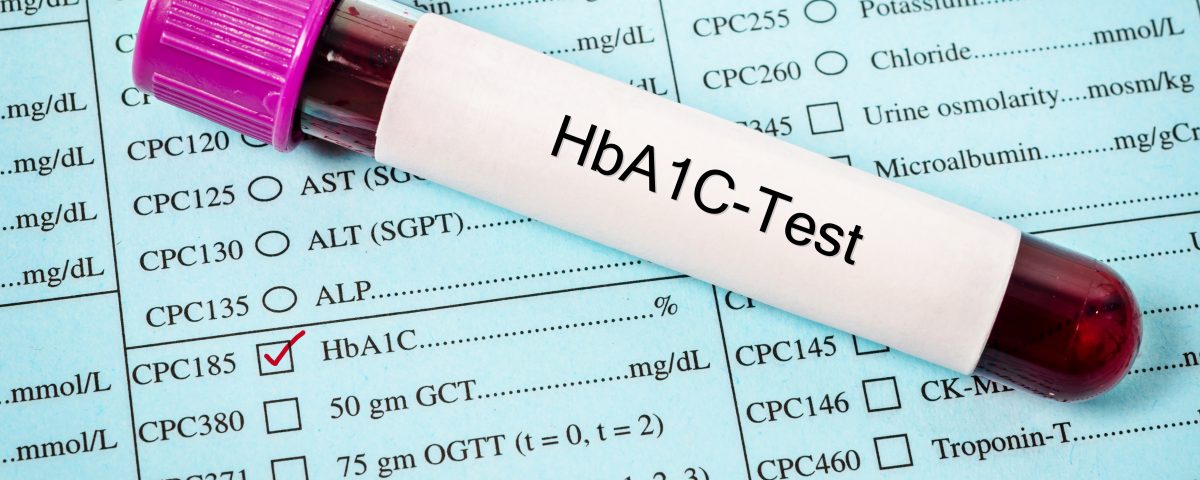
Hemoglobin A1c test with sample blood in blood tube.
The A1C test is one of the most trusted tools in diabetes care. A single blood draw gives an estimate of average blood sugar over the past two to three months, and doctors use it both to screen for prediabetes and diabetes and to judge whether diabetes treatment is working. A result below 5.7% is generally considered normal, 5.7% to 6.4% suggests prediabetes, and 6.5% or higher points toward diabetes.
A study presented in October 2026 is a reminder that even a cornerstone test has blind spots. In people with a common inherited blood condition called glucose-6-phosphate dehydrogenase (G6PD) deficiency, A1C came out substantially lower than their actual blood sugar would suggest — low enough, in many cases, to miss abnormal glucose entirely.
What A1C actually measures
A1C, also written HbA1c, measures the percentage of hemoglobin — the protein inside red blood cells that carries oxygen — that has glucose attached to it. Because red blood cells live for roughly two to three months, the test reflects average glucose over that window rather than a single moment.
That design is also its vulnerability. Anything that changes red blood cells themselves — how long they live, or the structure of their hemoglobin — can shift the A1C result without changing a person’s actual blood sugar. G6PD deficiency is one such condition. It affects an enzyme that protects red blood cells from damage, and people with the deficiency are more prone to their red blood cells breaking down early. With less time for glucose to attach to hemoglobin, the A1C reading comes out lower.
What the researchers did
The findings were presented on October 21, 2026, by Amy Bentley, PhD, of the National Human Genome Research Institute, at the American Society of Human Genetics annual meeting. Researchers examined how well HbA1c performed among 759 Nigerians, and evaluated additional outcomes and alternative markers in 2,555 participants from Ghana, Nigeria, and Kenya. They focused on two inherited blood conditions common in West Africa: G6PD deficiency and sickle cell trait.
Crucially, the researchers did not rely on A1C alone. They also looked at fasting glucose and fructosamine, a marker of average blood sugar that is not based on hemoglobin, so they could tell whether a low A1C meant genuinely lower blood sugar or simply a misleading test.
The headline numbers
The gap was large, not marginal:
- A1C was 0.7 percentage points lower in people with G6PD deficiency, even though their fasting glucose, fructosamine, and rates of type 2 diabetes were no different.
- A1C detected only 14.3% of abnormal glucose tolerance cases among participants with G6PD deficiency, compared with 49% across the full dataset. In other words, most cases were missed in this group.
- For diabetes monitoring, A1C missed poor glucose control about three times more often in people with G6PD deficiency than in people without it. A reassuring A1C could therefore hide blood sugar that was not actually under control.
Sickle cell trait — having one sickle cell gene without having sickle cell disease — had a smaller effect in the opposite direction, modestly raising A1C and sometimes overclassifying poor control.
A promising alternative marker
One encouraging finding concerned fructosamine. Unlike A1C, fructosamine measures glucose attached to proteins in the blood serum rather than to hemoglobin inside red blood cells, so it is not distorted in the same way when red blood cells break down early. In this study, fructosamine performed consistently across genetic subgroups when used for diabetes monitoring.
The researchers also reported that a clinical algorithm combining routine blood measurements could identify likely G6PD deficiency with more than 80% sensitivity and specificity. That is promising as a way to flag who might need a different test, but it is not yet a routine clinical tool.
What this doesn’t prove — and why A1C is still useful
The caveats matter, and the researchers state them plainly:
- These findings still need validation before they change practice. The results were presented at a scientific meeting, and the study authors note that locally calibrated A1C criteria, targeted G6PD screening, and alternative biomarkers may help reduce missed results — but further validation is needed before implementation.
- The study populations were West African. G6PD deficiency and sickle cell trait are more common in parts of Africa, the Mediterranean, the Middle East, and Asia, and the size of the A1C distortion may differ in other populations. The lesson is general — red blood cell conditions can distort A1C — but the exact numbers should not be assumed to apply everywhere.
- A1C remains a good test for most people. This study does not overturn A1C. For people without a red blood cell condition, it remains a convenient, well-validated measure. The problem is specific: when a red blood cell condition is present, A1C alone can mislead.
What you can do
- Know whether a red blood cell condition applies to you. If you have G6PD deficiency, sickle cell trait or disease, anemia, or another hemoglobin condition — or if you have family origins in a region where G6PD deficiency is common — mention it when discussing diabetes screening or monitoring.
- Look for a mismatch. If your A1C does not match your fasting glucose, your symptoms, or how you feel your diabetes is going, that mismatch is worth raising rather than ignoring. A clinician may suggest a fasting glucose test, an oral glucose tolerance test, or a fructosamine test as a cross-check.
- Talk to your doctor or clinician about your results. Do not adjust medication or conclude that you do or do not have diabetes based on one A1C result alone. A1C and fructosamine tests are available through labs that let people order directly without a referral, including HealthOneLabs, but interpreting a result that may be distorted by a blood condition is a job for a clinician who knows your full history.
The bottom line
A1C earned its reputation for good reason, but it measures glucose through red blood cells — and when those cells behave differently, the number can lie. In this 2026 study, G6PD deficiency lowered A1C by 0.7 points and caused most cases of abnormal glucose to be missed. For most people, A1C remains reliable. For people with G6PD deficiency or a related blood condition, it may take a second, different kind of test to get the true picture.
Reference: Bentley, A., et al. Findings on HbA1c performance in G6PD deficiency and sickle cell trait, presented at the American Society of Human Genetics (ASHG) Annual Meeting, October 21, 2026. ASHG press release: “Common Genetic Condition May Mask Diabetes Risk and Poor Glucose Control.” https://www.ashg.org/publications-news/press-releases/common-genetic-condition-may-mask-diabetes-risk-and-poor-glucose-control/